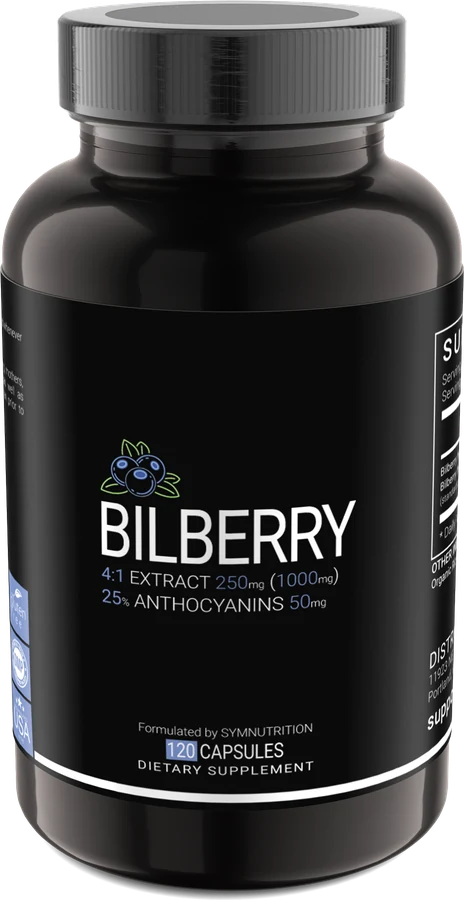
Bilberry Extract
Bilberry is a low-growing shrub of the heath family native to northern Europe and parts of Asia and North America. Its small dark-blue berries are a traditional food and a close relative of the North American blueberry. The fruit in this product is sourced from Finland, Latvia and Russia; the capsule combines a 4:1 whole-fruit extract with an extract standardised to 25% anthocyanins.
Night vision, eye fatigue from screen work, and the glucose response to a meal: placebo-controlled trials, a systematic review and a pharmacokinetic study. See the studies
On the label
Cellulose (vegetarian capsule), organic rice concentrate (NuFlow), rice flour.
As a dietary supplement, take one capsule with food whenever preferred. Do not consume more than four capsules per day.
The other two ingredients
Apart from the bilberry extracts, the capsule holds two things: rice flour and a cellulose shell. Both are food.
The shell is hypromellose, which is plant cellulose refined into a clear film. It keeps the powder dry until you swallow it, then dissolves in the stomach in a few minutes. No gelatin, so nothing from an animal, and no colouring.
Three hundred milligrams of bilberry extract is a small pinch. On its own it would sit loose in a half-empty shell, and a half-empty capsule cannot be filled to a consistent weight. Rice flour makes up the difference. Each capsule is filled to the same weight, and that weight is how the dose is checked.
This powder is sticky, so a little organic rice concentrate (NuFlow) goes in to keep it flowing evenly on the filling machine. It is finely ground rice hull and nothing more. It does the job most brands give to silicon dioxide.
That is the full list. Nothing else goes in.
What the bottle does
The bottle is amber PET. It is what the pharmaceutical industry uses for tablets and capsules because, of the common bottle plastics, it lets the least oxygen through. It has no BPA and no phthalates in it. It does not break like glass and weighs much less, so shipping it takes less fuel. It is also the most recycled plastic there is, the number one inside the triangle on the base.
Light, air and moisture are what age a capsule. The amber tint blocks the ultraviolet. A tear-resistant seal under the cap keeps air and moisture out until you break it.
A band around the neck shows the bottle has not been opened since it was filled. A cotton insert stops the capsules rattling and breaking in the post. The lot number and date on the base link the bottle to its certificate.
Keep it somewhere cool, dry and dark.
Questions about Bilberry Extract
What does 4:1 mean, and what is the 25%?
The pigment is the part that gets measured. The 50 mg standardised to 25% anthocyanins guarantees 12.5 mg of it in every capsule, whatever the harvest. The 250 mg of 4:1 extract is the whole berry concentrated four times, so it stands for about 1,000 mg of fruit, with everything the fruit contains in the proportions it grew in.
Is bilberry the same as blueberry?
A close relative, not the same species. Bilberry is Vaccinium myrtillus, a smaller wild berry whose dark pigment runs through the flesh, where a blueberry's sits mostly in the skin. The fruit in this product comes from Finland, Latvia and Russia.
How do I get the certificate for my lot?
Email the lot number printed on the base of your bottle to support@symnutrition.com and we will send the certificate of analysis for that lot within two business days.
The studies
These are some of the studies that convinced us this was a product worth making. There is an inherent bias in the interaction between a brand and its customer, so we do not summarise them for you. Each is listed as published with its design, size and dose, including the ones with mixed or null results, and the link goes to the paper. Read them, and do your own research using unbiased and reputable sources.
-
The effect of bilberry nutritional supplementation on night visual acuity and contrast sensitivity
Muth ER et al. (2000). Alternative Medicine Review. Double-blind, placebo-controlled crossover, n = 15, 160 mg of 25% anthocyanoside extract three times daily for 21 days.
-
Canter PH, Ernst E (2004). Survey of Ophthalmology. Systematic review of 12 placebo-controlled trials.
-
Bilberry extract supplementation for preventing eye fatigue in video display terminal workers
Ozawa Y et al. (2015). Journal of Nutrition, Health and Aging. Randomised, double-blind, placebo-controlled, n = 80, 480 mg/day for 8 weeks.
-
Kosehira M et al. (2020). Nutrients. Randomised, double-blind, placebo-controlled, n = 109, 240 mg standardised extract daily for 12 weeks.
-
Hoggard N et al. (2013). Journal of Nutritional Science. Double-blind crossover, n = 8, single 0.47 g dose of 36% anthocyanin extract.
-
Sakakibara H et al. (2014). Bioscience, Biotechnology, and Biochemistry. Human pharmacokinetic study, n = 13, 919 µmol bilberry anthocyanins.
Bilberry Extract 250mg 4:1 extract (1,000mg fruit equivalent) + 50mg extract standardised to 25% anthocyanins (12.5mg), per capsule, 120 vegetable capsules
Six-month refund. If anything is not right, email your Amazon order ID and we will sort it out. No questions.