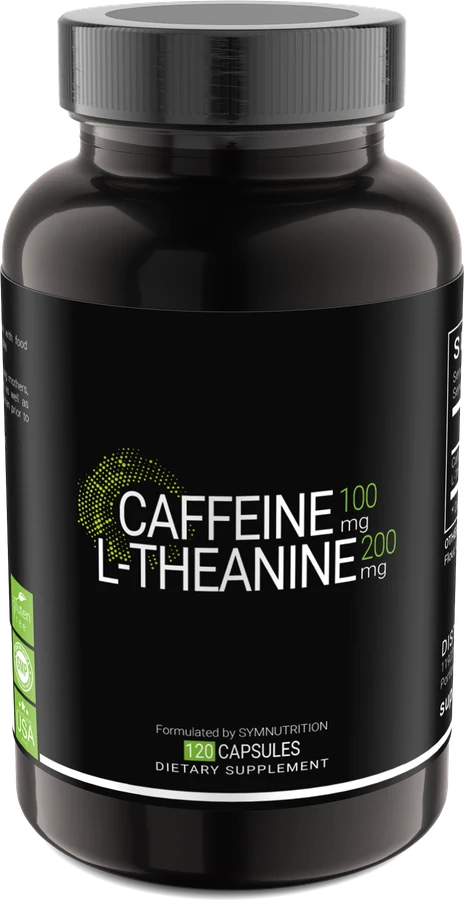
L-Theanine + Caffeine
Caffeine is a methylxanthine alkaloid found in coffee beans, tea leaves, cacao and guarana. L-theanine is an amino acid found in tea leaves. The two occur together naturally in brewed tea, and the combination has been studied in controlled trials mostly at tea-like ratios of roughly 40 to 75 mg caffeine to 50 to 100 mg theanine; this capsule uses 200 mg and 100 mg.
Attention, task switching and self-rated alertness in the hours after a dose, at tea-like ratios: four placebo-controlled trials and two meta-analyses. See the studies
On the label
Hypromellose (vegetarian capsule), rice flour, organic rice concentrate (NuFlow).
As a dietary supplement, take one capsule with food whenever preferred. Do not consume more than four capsules per day.
The other two ingredients
Apart from the L-theanine and caffeine, the capsule holds two things: rice flour and a cellulose shell. Both are food.
The shell is hypromellose, which is plant cellulose refined into a clear film. It keeps the powder dry until you swallow it, then dissolves in the stomach in a few minutes. No gelatin, so nothing from an animal, and no colouring.
Three hundred milligrams of L-theanine and caffeine is a small pinch. On its own it would sit loose in a half-empty shell, and a half-empty capsule cannot be filled to a consistent weight. Rice flour makes up the difference. Each capsule is filled to the same weight, and that weight is how the dose is checked.
This powder is sticky, so a little organic rice concentrate (NuFlow) goes in to keep it flowing evenly on the filling machine. It is finely ground rice hull and nothing more. It does the job most brands give to silicon dioxide.
That is the full list. Nothing else goes in.
What the bottle does
The bottle is amber PET. It is what the pharmaceutical industry uses for tablets and capsules because, of the common bottle plastics, it lets the least oxygen through. It has no BPA and no phthalates in it. It does not break like glass and weighs much less, so shipping it takes less fuel. It is also the most recycled plastic there is, the number one inside the triangle on the base.
Light, air and moisture are what age a capsule. The amber tint blocks the ultraviolet. A tear-resistant seal under the cap keeps air and moisture out until you break it.
A band around the neck shows the bottle has not been opened since it was filled. A cotton insert stops the capsules rattling and breaking in the post. The lot number and date on the base link the bottle to its certificate.
Keep it somewhere cool, dry and dark.
Questions about L-Theanine + Caffeine
Why 200 mg and 100 mg?
The 200 mg of L-theanine is the dose most single-ingredient theanine trials used. A typical cup of coffee carries 80 to 100 mg of caffeine, so the 100 mg is about a cup's worth. The combination trials below mostly used smaller, tea-like amounts, which is why they are listed as published rather than as support for this exact ratio.
Why the four-capsule limit?
Four capsules is 400 mg of caffeine, the daily amount the FDA cites as not generally associated with dangerous effects in healthy adults. Count what you drink in coffee and tea against the same figure.
How do I get the certificate for my lot?
Email the lot number printed on the base of your bottle to support@symnutrition.com and we will send the certificate of analysis for that lot within two business days.
The studies
These are some of the studies that convinced us this was a product worth making. There is an inherent bias in the interaction between a brand and its customer, so we do not summarise them for you. Each is listed as published with its design, size and dose, including the ones with mixed or null results, and the link goes to the paper. Read them, and do your own research using unbiased and reputable sources.
-
The combined effects of L-theanine and caffeine on cognitive performance and mood
Owen GN et al. (2008). Nutritional Neuroscience. Randomised, double-blind, placebo-controlled crossover, n = 27, 50 mg caffeine + 100 mg L-theanine.
-
Giesbrecht T et al. (2010). Nutritional Neuroscience. Randomised, double-blind, placebo-controlled crossover, n = 44, 40 mg caffeine + 97 mg L-theanine.
-
Einöther SJ et al. (2010). Appetite. Randomised, double-blind, placebo-controlled crossover, n = 29, 40 mg caffeine + 97 mg L-theanine.
-
Dodd FL et al. (2015). Psychopharmacology. Counterbalanced crossover, n = 24, 75 mg caffeine + 50 mg L-theanine.
-
Camfield DA et al. (2014). Nutrition Reviews. Systematic review and meta-analysis of 11 RCTs.
-
Payne ER et al. (2025). Nutrition Reviews. Systematic review and meta-analysis, 16 trials pooled, n = 484.
L-Theanine + Caffeine 200mg + 100mg per capsule, 120 vegetable capsules
Six-month refund. If anything is not right, email your Amazon order ID and we will sort it out. No questions.